Do you remember the first time you sat behind the wheel of a car? Your hands gripping the steering wheel way too tight, your heart beating a little faster than usual, convinced you were going to crash into something. And now you drive without even thinking about it, changing lanes, parking, navigating roundabouts while sipping your coffee.
Investing is exactly the same. Right now, it probably feels overwhelming. Too many options, too much jargon, too much risk. But by the end of this guide, you will have a complete roadmap to get started, put your money on autopilot, and let it grow while you sleep.
Not through luck, not through stock picking. Just through patience and a bit of basic maths. Let me show you exactly how to get there.
Why You Need to Invest (And Why Saving Is Not Enough)
Let us start with something most people do not think about, and it is the reason a lot of new investors end up worse off than when they started.
Imagine you have €10,000. If you keep it under the mattress for 20 years, you still have €10,000 on paper. But because of inflation, that money can only buy about €5,500 worth of stuff. You have lost almost half your purchasing power without spending a single cent. That is inflation quietly eating your savings alive.
A savings account is a better option. At roughly 2% per year, which is the current rate across most of Europe, your €10,000 grows to about €14,000 over that same period. That is decent, but it barely keeps up with inflation. You are essentially running on a treadmill, moving your legs but going nowhere.
Now, if you invested the same €10,000 in the S&P 500, which is an index of the 500 largest US companies, at an average return of about 8% per year (the historical average over the last 30 years), you would end up with roughly €46,000. That is a 360% increase. Same starting amount, completely different outcome. The only difference is where you parked your money.
Why Starting Early Matters More Than Investing More
It is not just about how much you invest. It is about when you start.
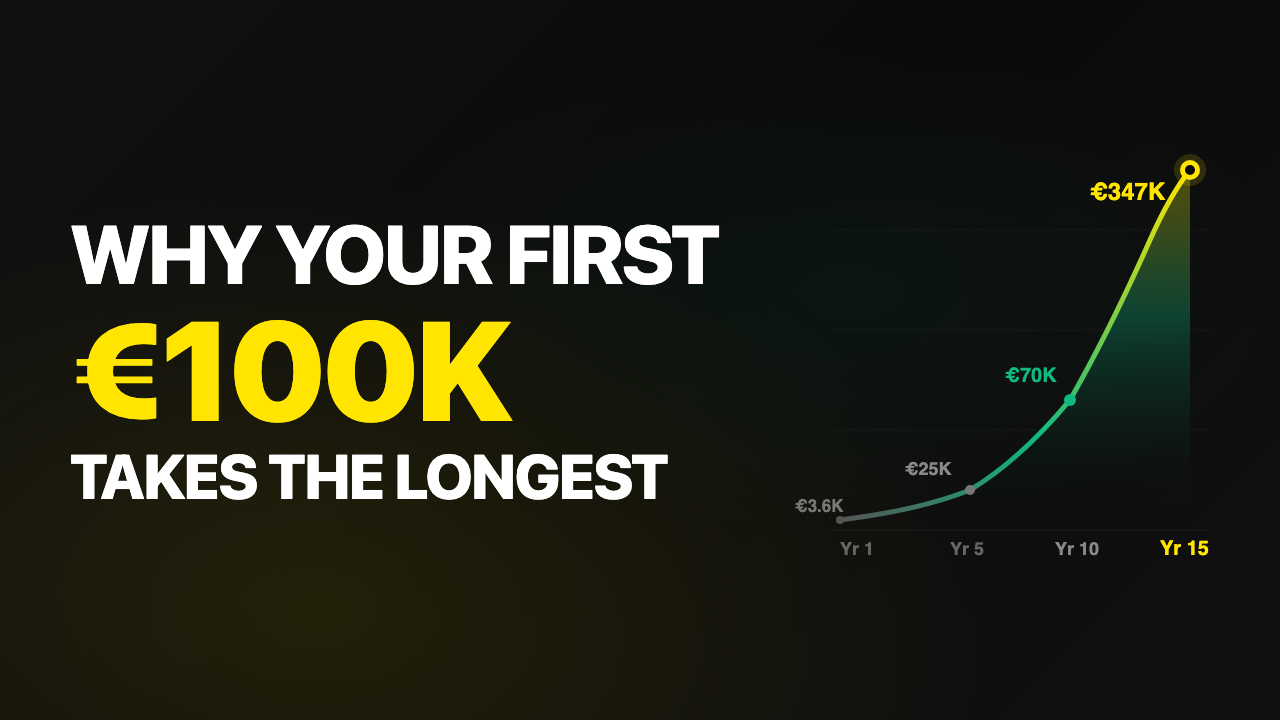
Person A invested less money overall and ended up with €32,000 more. The only difference was time. Those 10 extra years of compound growth were worth more than doubling the monthly contribution. This is exactly why the first €100K takes the longest, but once you cross that threshold, compounding really starts doing the heavy lifting.
Starting now, even with small amounts, is far more powerful than waiting until you can afford to invest more.
Step 0: Build Your Emergency Fund
Before you rush to open a broker account, you need your learner's permit first. In investing terms, that is an emergency fund. This is money set aside for unexpected expenses. Your car breaks down, you lose a job, your laptop dies the day before a deadline. Life happens, and you do not want to be forced to sell your investments at a loss just because you need cash in a hurry.
How much you need depends on your situation:
- Single, early career: 3 to 4 months of expenses
- Couple with a mortgage: around 6 months
- Family with kids and higher expenses: 9 to 12 months
I personally started with 3 months, then went to 6, and now I keep well over 12 months because I value the peace of mind. Keep this money somewhere easily accessible that still earns interest. High-yield savings accounts from platforms like Trading 212, Bondora, or Monefit work well for this. No lock-up periods, easy to access, and earning you interest while it sits there.
Once that is in place, everything else you earn can go towards investing.
How You Make Money From Investing
There are two main ways your investments generate returns.
The first is capital appreciation. You buy something for €100, and over time the value goes up to €180. You have made an 80% profit. Simple.
The second is dividends. Some companies pay you just for holding their stock. Every quarter, they send you a share of their profits. If you own a dividend-paying stock, you might receive €50 every quarter, adding up to around €200 a year in passive income without doing anything.
The best investments give you both: your stock grows in value over time, and it pays you a dividend along the way. That combined effect is your total return. And when you reinvest those dividends to buy more shares, the snowball effect really kicks in.
Stocks, Indices, and ETFs Explained
When you buy a stock, you are buying a tiny piece of a company. If Apple has millions of shares and you buy one, you own a small fraction of Apple. You are a part owner.
There are two main types of stocks. Growth stocks like Apple, Microsoft, and Nvidia focus on growing their value. They usually reinvest all their profits back into the business rather than paying dividends. Then there are dividend stocks like Coca-Cola and Realty Income, which pay regular income on top of any price growth.
Now, you will hear people say "just buy the S&P 500." But what does that actually mean? An index is simply a list that tracks the performance of a group of companies. You cannot buy it directly, it is just a measurement. The S&P 500 tracks the 500 largest companies in the US. The Nasdaq 100 tracks the 100 largest tech-heavy companies. The MSCI World tracks over 1,500 companies from more than 20 countries.
An ETF (Exchange Traded Fund) is the actual product from a provider like Vanguard or iShares that follows one of these indices. When somebody says "buy the S&P 500," what they really mean is buy an ETF that tracks it. The index is the list, the ETF is what you actually buy.
If you only take one thing from this guide, let it be this: you do not need to pick stocks. A single broad market ETF is a perfectly solid investment strategy, and many professionals cannot even beat it.
Think of an ETF like a tasting menu at a restaurant. You get a small portion of every great dish in the kitchen without having to guess what is good. And the bill is incredibly low, we are talking fees of around 0.03% to 0.07% per year.
Some popular ETFs available to European investors include VUAA (tracks the S&P 500), VWCE (tracks the entire world stock market), and EQQQ (tracks the Nasdaq 100). If you are unsure about picking individual stocks, there are also hands-off investing methods worth exploring.
Fractional Shares: You Do Not Need a Lot of Money
One thing that stops a lot of people from starting is thinking you need a lot of money. A share of Amazon costs over €200, so surely you need at least that much?
Not anymore. Most modern brokers now offer fractional shares. If a stock costs €1,000 per share, you can invest just €10 and own 1% of that share. You still benefit proportionately from all the gains and dividends. So there is literally no minimum anymore. €1 is enough to get started.
The Power of Compound Growth
This is the engine that makes the whole thing work. Let us look at what happens when you invest €200 a month at an average return of 8% per year.
After 10 years, you have put in €24,000 and your portfolio is worth about €36,000. After 20 years, you have invested €48,000, but your portfolio is now worth €117,000. And after 30 years, you have put in €72,000, but your portfolio has grown to roughly €298,000. Over €226,000 of pure growth from doing nothing except being patient and consistent.
Picture a snowball at the top of a long hill. You give it a push, and for the first few metres it barely grows. But halfway down, it picks up so much snow that it is going faster than you could ever keep up with. By the time it reaches the bottom, it is enormous. That is exactly how compound growth works. Your returns earn their own returns, and those returns start earning returns on themselves.
Market Crashes Are Normal
Here is something that scares a lot of beginners away from investing entirely. Markets will drop. Not might, will. In 2008, the S&P 500 dropped by 38%. In 2020, it dropped by 34%. In 2022, it dropped by 25%.
Every single time, it felt like the world was ending. And every single time, the markets recovered and went on to hit new all-time highs. If you had sold during those crashes, you would have locked in your losses and missed the recovery. But if you stayed invested, or even better, kept buying during the dip, you came out ahead every single time.
The lesson is simple: expect drops, plan for them, but do not react to them. The people who win at investing are not the ones avoiding the dips. They are the ones sitting through them. I experienced this firsthand when I lost $52,000 in a single week, and staying the course was the right call.
Other Asset Classes to Consider
Stocks and ETFs are just one type of asset class. As your wealth grows, you will want to diversify into other areas too. There are bonds (loans to governments or companies), real estate (either physical property or through REITs), Bitcoin and crypto for those comfortable with higher volatility, commodities like gold and silver, high-yield savings accounts for interest income, and P2P lending platforms like Bondora or Monefit for higher yields.
I personally invest across many of these asset classes. But as a beginner, do not overthink it. Start with stocks and ETFs and gradually add other things over time. You would not try to drive a manual, automatic, and a motorcycle all in the same week. Master one first, then move on.
Diversification: Do Not Put All Your Eggs in One Basket
You want to diversify across three dimensions. First, across different sectors. Do not go all in on US tech alone. It is exciting, but it might have a bad period. Spread into healthcare, energy, and other sectors too.
Second, across different asset classes. As mentioned, there is not just stocks out there. Eventually you might want to add real estate, P2P lending, bonds, or crypto. Different asset classes move in different cycles.
Third, across different brokers. If you put all your money in one single broker and something goes wrong, that is a problem. I think it is sensible to have at least two. I wrote a deeper breakdown of what a real crisis taught me about diversification if you want to go further on this topic.
How to Start in 3 Simple Steps
Broker Recommendations
These are three brokers I personally use and recommend. I compare brokers extensively on my channel and these consistently come out on top.
Interactive Brokers is the most professional-grade option with the lowest fees. Access to global markets, auto-invest features, and fractional shares. If you want the best value for money long term, this is the one. For a full comparison, check out my best stock brokers guide.
eToro is great if you are interested in social investing and copy trading. Very beginner-friendly, and they are currently offering up to €500 welcome bonus when you sign up with my link.
Trading 212 is commission-free with a great Pies feature that lets you build custom portfolios and auto-invest into them. You also get a free fractional share worth up to €100 when you sign up with my link. I wrote a full beginner's guide to Trading 212 if you want a step-by-step walkthrough.
All three support fractional shares and auto-investing.
Set It on Autopilot
This is my favourite part, because this is where investing stops feeling like work. The best strategy is the one you actually stick to, and the easiest way to stick to it is to take yourself out of the equation entirely.
Set up a standing order from your bank to your broker so money moves automatically every week or every month. Then configure auto-invest in your broker app so that money gets invested automatically into your chosen ETF or stocks. Your bank sends money to your broker, your broker invests it, and your money starts working for you. You do not have to think about it, log in, or make any decisions. It takes five minutes to set up and then it runs on autopilot.
Tax-Advantaged Accounts
Depending on where you live, some countries offer tax-advantaged accounts where your investments grow tax-free or tax-deferred.
If you are in the UK, you have access to a Stocks and Shares ISA. Any gains and dividends inside your ISA are completely tax-free, with a current allowance of £20,000 per year. Most UK brokers offer ISA accounts, so there is really no reason not to use one.
If you are in Europe or elsewhere, tax rules vary significantly by country. Capital gains tax rates can range from 0% to over 30% depending on where you live. Research the specific rules in your country, but here is the key takeaway: do not let taxes stop you from investing. Even after taxes, investing beats not investing. If a tax-advantaged wrapper is available, use it. If not, invest anyway.
Track Your Progress
As you get more comfortable, tracking your net worth is one of the most motivating things you can do. I track my own finances monthly, recording all income and expenses to manage my budget, and updating my overall net worth across all brokers and asset classes.
For stock research, Seeking Alpha is the platform I use for in-depth analysis. I check analyst ratings, earnings data, valuation metrics, and dividend histories before making any investment decision.
6 Common Beginner Mistakes to Avoid
These are the potholes in the road that trip up almost everyone. I have hit a few of them myself. For a deeper dive, check out my full article on investing mistakes to avoid.
- Trying to time the market. Nobody can consistently predict market tops and bottoms. Time in the market beats timing the market every single time.
- Panic selling during dips. Markets drop, but historically they have always recovered. Selling during a dip locks in your losses and means you miss the recovery.
- Following hype and meme stocks. If everyone on Reddit is talking about a stock, you are probably already too late. Boring, consistent investing beats chasing the next hot thing.
- Not diversifying. Going all in on a single stock is not investing. That is gambling with extra steps.
- Checking your portfolio every day. On any given day, the market is roughly a coin flip. Checking daily just creates anxiety for no reason. Think in years, not days.
- Not having an emergency fund. Without a cash buffer, unexpected expenses can force you to sell your investments at the worst possible time.
Your Action Plan
1. Build your safety net. Save 3 to 12 months of expenses in a high-interest account.
2. Open a broker. Pick one from the list above. Sign up this week, not next week.
3. Set up automatic investments. Even €50 a month counts. Configure auto-invest into a broad market ETF.
4. Learn as you go. Listen to podcasts, read articles, watch videos. But most importantly, learn by doing. Starting with small amounts teaches you more than any book.
The best time to start investing was yesterday. The second best time is today. Every month you wait is a month of compound growth you will never get back. That snowball is waiting at the top of the hill. All you have to do is give it a push.
Free 7-Day Investing Course
If you want to keep learning, I put together a free 7-day investing email course. One lesson per day, straight to your inbox. It covers everything from picking your first ETF to understanding fees and building a long-term strategy.
Frequently Asked Questions
You can start with as little as €1. Most modern brokers offer fractional shares, meaning you can own a piece of any stock or ETF without needing hundreds of euros for a single share.
A broad market ETF like a S&P 500 ETF (e.g. VUAA) or an All-World ETF (e.g. VWCE) is widely considered the best starting point. It gives you instant diversification across hundreds of companies in a single purchase.
An index is a list that tracks the performance of a group of companies, like the S&P 500. You cannot buy an index directly. An ETF (Exchange Traded Fund) is the actual product from a provider like Vanguard or iShares that follows an index. When someone says "buy the S&P 500," they mean buy an ETF that tracks it.
Yes. Markets will drop, that is normal. The S&P 500 dropped 38% in 2008, 34% in 2020, and 25% in 2022. Every single time, it recovered and went on to hit new all-time highs. The people who win at investing are not those avoiding dips, but those sitting through them.
Compound growth means your returns earn their own returns over time. Investing €200 per month at 8% annually turns into roughly €298,000 over 30 years, even though you only put in €72,000 of your own money. The remaining €226,000 is pure compound growth.
Set up a standing order from your bank to your broker account, then configure the auto-invest feature in your broker app. Your money gets transferred and invested automatically every week or month without you having to do anything.
Disclaimer: This article is for educational purposes only and does not constitute financial advice. When investing, your capital is at risk. You may get back less than you invested. Past performance is not a guarantee of future results. This article contains affiliate links, meaning I may earn a small commission if you sign up through them, at no additional cost to you.